Under The Dome: Capitol Insights from UEA
Under The Dome: Insights from UEA delivers daily e-newsletters to registered activists during legislative sessions, providing updates on moving bills, highlights from committee discussions, and actionable steps to engage in fast-moving legislation.
Interim Session Begins With Early Look at Retirement, Revenue and Educator Licensing
May 2026
After the 45-day general session, lawmakers meet monthly in interim standing and appropriations committees from May through November, except in July. During interim, committees study policy issues, hear reports and may open committee bills for consideration in the next general session.
May interim meetings included several items affecting public educators and public education funding.
Retirement and Independent Entities Interim Committee
The committee heard a presentation from the Utah Retirement Systems on benefits currently available to Tier 2 URS members. Public educators participate in URS.
Committee members discussed possible changes to Tier 2 and requested additional analysis and actuarial data from URS for future meetings.
Executive Appropriations Committee
Fiscal analysts presented updated revenue projections for the income tax, General Fund and Transportation Fund.
The current state revenue forecast projects a 2.7% increase in the income tax fund in fiscal year 2027. The income tax fund is the primary source of public education funding in Utah.
Education Interim Committee
The committee discussed two items: Advanced Placement and concurrent enrollment, and teacher licensing.
Rep. Douglas Welton raised concerns that some teachers view AP courses as more rigorous than concurrent enrollment courses, even though concurrent enrollment courses are guaranteed to provide college credit while AP credit is not guaranteed.
Lawmakers discussed the purpose of concurrent enrollment and the appropriate rigor for courses that earn college credit. No action was taken.
The committee also discussed teacher licensing, including licensure requirements that exceed 120 credit hours and whether a subject-matter bachelor’s degree combined with a master’s degree in education could serve as an appropriate pathway to licensure. One example discussed was a potential Master of Arts in Teaching program for elementary education at Utah Valley University.
No action was taken on either of the education items. Discussions about possible policy changes are expected to continue throughout the interim.
Education Budget Proposal Leaves Key Educator Priorities Unfunded
March 6, 2026
On Thursday, the Public Education Appropriations Subcommittee released its final funding proposal for the session, outlining its education funding priorities.
While we appreciate the committee’s work on the education budget, we are disappointed the proposal did not include two important educator priorities for the Utah Education Association: SB 75, which would have added registered school nurses to the educator salary adjustment, and HB 150, which would have included speech-language pathologists in classroom supply funding. Both measures recognize the critical role these educators play in supporting students and schools.
The proposal also changes the language related to the Utah Schools for the Deaf and the Blind (USDB) salary schedule. Originally, the Public Education Appropriations Subcommittee proposed moving USDB educators from a steps-and-lanes salary structure to a merit-based schedule.
The final proposal instead directs that the issue be studied over the coming year rather than implementing changes this session.
Additional Proposed Funding Items, 2026 General Session
Consolidated Motions for End of Session Budget Actions, 2026 General Session
Bill Allowing Educators with Suspended License Back in Schools Passes Legislature
The Utah legislature passed a bill Thursday that would allow educators with a suspended license to be employed in or volunteer in public schools.
SB 312 Sub 1 Educator License Amendments differentiates between a suspended license resulting from “technical violations” and “serious misconduct”. However, existing USBE administrative rule does not result in license suspension for minor educator misconduct, technical or otherwise. According to Board rule, license suspension is currently presumed for actions such as: failing to report to appropriate authorities suspected child or sexual abuse; failing to inform a parent of a student's threat of suicide, self-harm, or harm to others; bullying or threatening a student physically, verbally, or electronically or engaging in multiple incidents or a pattern of theft or misappropriation of public funds that does not result in a criminal conviction.
UEA opposes the bill because it would weaken the guardrails that sanction serious educator misconduct, increasing risk and liability for schools and undermining educator professional conduct. UEA’s work to ensure educators have due process rights when facing allegations of misconduct has sometimes been criticized as protecting “bad teachers”. This sentiment was proven false by UEA’s opposition to passing legislation that would allow educators, under certain circumstances, with a suspended license to work in public schools.
It should also be noted that UEA strongly believes that while suspension may be necessary in some circumstances, it does not mean a teacher should not have the opportunity to return to the classroom after they have satisfied the terms of the suspension. Once they have completed their rehabilitation and have been reviewed by UPPAC and USBE, they should be welcomed back into the classroom. This bill allows the return to schools prior to completing the terms of their suspension.
The bill raced through the legislative process. The first committee hearing was on February 26, and it passed out of the Senate on March 3 and the House on March 5. It now heads to Gov. Spencer Cox's desk where he can sign it into law or repeal the bill.
Mandated Curriculum, License Changes Move Forward During Final Days
March 5, 2026
H.B. 315 Sub 2 — Human Growth and Development Instruction
Sponsor: Rep. Nicholeen Peck (R), District 28 (Tooele County)
Committee: Senate Judiciary
Summary: Requires showing a specific fetal development video as part of human growth and development curriculum.
UEA position: Oppose. UEA opposes the bill because it mandates curriculum, circumvents local control, is highly prescriptive, and requires showing the controversial “Baby Olivia” video.
Testimony: Chelsie Acosta, SLEA member and 7th-grade health teacher, spoke against the bill, stating: “This bill violates parental rights, this bill violates local control, this bill is too prescriptive, and the bill is unnecessary.” (Video link below.)
Vote: Passed 4-2 along party lines.
S.B. 312 Sub 1 — Educator License Amendments
Sponsor: Sen. John Johnson (R), District 3 (Morgan, Summit & Weber counties)
Committee: House Education
Summary: Amends the statute governing the Utah Professional Practices Advisory Commission (UPPAC) to define circumstances under which an educator with a suspended or revoked license may be employed in or volunteer in a public school. A substitute version was made public and adopted shortly before the committee meeting ended.
UEA position: Oppose. The substitute provides some clarity, but the bill’s underlying intent remains. UEA opposes the bill because it weakens the significance of a suspension or revocation of an educator’s license and undermines educator professionalism. (Video link below.)
Vote: Passed 7-3.
H.B. 521 — Public Education Economic Stabilization Restricted Account Amendments
Sponsor: Rep. Neil Walter (R), District 74 (Washington County)
Committee: Senate Revenue and Tax
Summary: Establishes a Public Education Stabilization Trust Fund and directs stabilization funds to be deposited and invested to support future public education needs. Rep. Walter requested the bill be moved to the interim for further study.
UEA position: Watch
Vote: Did not advance out of committee.
H.B. 235 — Income Tax Revisions
Sponsor: Rep. Christofferson (R), District 53 (Utah County)
Committee: Senate Revenue and Tax
Summary: Reduces Utah’s corporate and individual income tax rate from 4.5% to 4.45%.
UEA position: Oppose. UEA expresses concerns over cutting taxes if public education isn’t fully funded.
Vote: Passed unanimously.
H.B. 329 Sub 3 — State Employee Maternity Leave Amendments
Sponsor: Rep. Defay (R), District 15 (Utah County)
Committee: Senate Revenue and Tax
Summary: Expands state employee family leave by increasing postpartum recovery leave to six weeks and creating paid adoption and foster leave options.
UEA position: Support
Vote: Passed unanimously.
H.B. 502 Sub 4 — School Attendance Modifications
Sponsor: Rep. Doug Welton (R), District 65 (Utah County)
Committee: Senate Government Operations and Political Subdivisions
Summary: Expands state employee family leave by increasing postpartum recovery leave to six weeks and creating paid adoption and foster leave options.
UEA position: Support
Vote: Passed unanimously.
H.B. 183 Sub 2 — Sex Designation Amendments
Sponsor: Rep. Strong (R), District 47 (Salt Lake County)
Committee: Senate Government Operations and Political Subdivisions
Summary: Replaces references to “gender” with “sex” in statute and requires state agencies to use biological sex terminology in rules, policies, and programs.
UEA position: Oppose
Vote: Passed unanimously.
H.B. 197 Sub 4 — School Materials Amendments
Sponsor: Rep. Nicholeen Peck (R), District 28 (Tooele County)
Committee: Senate Government Operations and Political Subdivisions
Summary: Modifies policies on sensitive instructional materials in schools, including requirements for reviewing and removing certain digital instructional materials.
UEA position: Oppose
Vote: Held in committee after multiple substitutes were considered.
House Education Advances Two of Seven Senate Bills
March 4, 2026
The House Education Committee heard a lengthy agenda March 3 but advanced only two of seven Senate bills. Five measures did not move forward, signaling limited momentum for several Senate proposals as the session nears its final committee meeting.
Passed out of committee
- SB 62 School Finance Amendments (Sub. 3) — Sen. Lincoln Fillmore (R-Salt Lake Co.) presented his bill which has changed significantly. The original bill would have changed the current weighted pupil unit funding formula for schools. However, Sub 3 is completely different, and it changes the term “flexible allocation” to “teacher and classroom support” and defines uses for that funding line item. UEA opposed the original bill but has no position on the substitute. The bill passed unanimously.
- SB 167 Reintegration for Disciplined Students — The bill tightens and expands the rules around how schools handle students who have committed serious disciplinary or criminal offenses. UEA supports the bill and it narrowly passed 6-4.
Held in committee
Bills that are “held” remain in committee and could return to a future agenda, though only one House Education Committee meeting remains this session.
- SB 180 School Nutrition Amendments — UEA supports.
- SB 269 School Board Meeting Notification Requirements — UEA not tracking.
- SB 119 School and Classroom Amendments — UEA opposes.
- SB 85 Excellence in Education and Leadership Supplement Modifications — UEA opposes.
Not heard
- SB 65 Minimum Basic Tax Rate Amendments — UEA opposes; committee adjourned before hearing the bill.
3% Raise in Final Education Budget
March 2, 2026
At its Friday meeting, the Utah Executive Appropriations Committee (EAC) finalized the public education budget. The budget is expected to provide an ongoing 3% increase to the educator salary adjustment. While helpful, but short of the 4% many stakeholders sought.
Notably, proposed intent language from the Public Education Appropriations Subcommittee that would have shifted Utah Schools for the Deaf and the Blind salary schedules away from step-and-lane structures toward merit-based pay was not included.
Funding for SB 75 Educator Salary Adjustment Eligibility was also absent from the proposal, though that does not mean it will not be funded. SB 75 is a UEA priority and would qualify school-registered nurses for the educator salary adjustment.
With fiscal note bills scheduled for prioritization on Tuesday, March 3, that process will be important to watch for additional education funding decisions.
H.B. 273 Sub 2 Classroom Technology Amendments
Sponsor: Rep. Ariel Defay (R) Dist. 15, Davis Co.
Committee: Senate Education
Summary: Known as the Balance Act, the bill requires USBE to create a model AI policy for LEAs and amend computer science course standards. It also limits technology use in elementary grades and creates a differentiated grade-level framework for technology use with K-3, 4-6, middle school and high school students. It also defines in statute a student “technology-related learning difficulty” that is not diagnosed or identifiable (such as would require an IEP or 504 accommodation) and requires LEAs to create a resource plan for the student.
UEA Position: Dr. Sara Jones, UEA Director of Government Relations, spoke in opposition to this section of the bill. She questioned the process by which a technology-related learning difficulty is determined. She also raised concern that placing the term in statute could create a new, legally required category of service for a student; obligate an educator or school to provide a minimal amount of services that are unfunded in the bill and potentially create liability for educators or schools if the “resource plan” is considered insufficient by a parent.
Vote: Passed out of committee with a vote of 3-2.
HB 315 Erodes Local Control Over Classroom Instruction
February 27, 2026
H.B. 315 Sub 1 Human Growth and Development Instruction
Sponsor: Rep. Nicholeen Peck (R) Dist. 28 Tooele Co.
Committee: House Education
Summary: Requires the use of a specific video on fetal development in grades 5 and 6 maturation courses. The bill language is prescriptive about what must be included in the video, leading to committee discussion about whether this is a “vendor bill”. During her presentation, Rep Peck specifically discussed the “Baby Olivia” video.
UEA Position: UEA opposes the bill because it mandates schools use a specific video on fetal development and circumvents the regular process for USBE and LEAs to vet and adopt appropriate curriculum aligned with state instructional standards.
Vote: After a lengthy discussion and public comment, the bill narrowly passed, 6-5.
SB 312 Weakens Educator Discipline and Student Safeguards
February 26, 2026
S.B. 312 Educator License Amendments (Sen. John Johnson, R- Morgan, Summit & Weber Counties) passed the Senate Education Committee on Wednesday with a favorable recommendation on a 4-1 vote.
The bill would change how educator discipline decisions from the Utah Professional Practices Advisory Commission affect an educator’s ability to work or volunteer in schools after a license suspension or revocation.
UEA believes the bill undermines the credibility and effectiveness of the commission’s process by diminishing the significance of a suspension. Currently, less serious infractions result in a letter of warning or a letter of reprimand. More serious infractions can result in a license suspension.
The bill would create exemptions in certain suspension cases. However, a suspension is a suspension, regardless of the violation, because it is based on the severity of the misconduct. If an infraction were not serious misconduct, it would not result in a suspension.
The current process is fair, works as intended and prioritizes student safety. SB 312 risks undermining that by blurring the meaning and consequences of a suspension.
Watch UEA Director of Campaigns and Elections Bonnie Billings speak against the bill during the Senate Education Committee in the video below.
UEA Priority Bill Advances Unanimously from Senate Education Committee
February 25, 2026
A Utah Education Association priority bill, HB 150 (Sub 2) School-Based Speech Language Pathologist Funding Amendments, (Rep. Jill Koford, R-Weber Co.) advanced Tuesday morning with a unanimous vote in the Senate Education Committee.
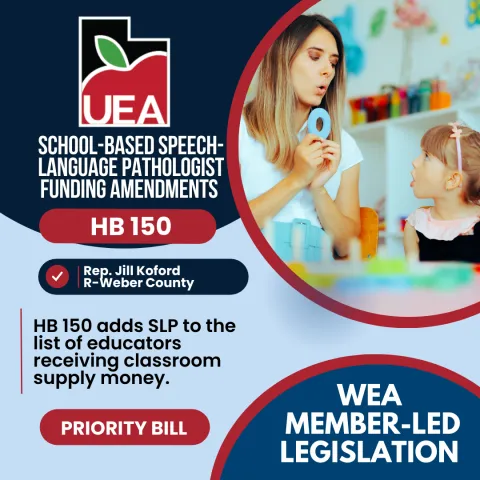
The bill restores eligibility for classroom supply funding for school-based speech-language pathologists (SLPs) and SLP technicians. Prior to 2024, SLPs received this funding, but a technical error in last year’s legislation inadvertently disqualified them. HB 150 (Sub 2) corrects that mistake and ensures these education professionals can once again access the classroom supply money they previously qualified for.
Dr. Sara Jones, UEA Director of Government Relations, spoke in support of the bill during the committee hearing.
The bill now heads to the next steps in the legislative process: it must be approved by the full Utah Senate, and the Executive Appropriations Committee must prioritize $494,000 in funding to fully implement the policy change.
H.B. 521 S1 Advances Plan to Grow Long-Term Education Funding
A proposal to create a new long-term funding mechanism for public education in Utah would allow money to be set aside in years when certain stabilization funds are not needed. H.B. 521: Public Education Economic Stabilization Restricted Account Amendments, sponsored by Rep. Niel Walter (R-Washington County), outlines how funds could be redirected to support public education over time. UEA is monitoring this bill and has not taken an official position.
The measure would allow up to $350 million to be swept into a public education trust or endowment if the state’s existing stabilization feature is not activated. Under the proposal, the fund would grow over time through interest earnings, with the long-term goal of increasing education funding beyond one-time expenditures and potentially supporting ongoing costs.
Lawmakers have also discussed the possibility that stronger long-term growth in the fund could contribute to lowering income tax rates in the future.
The bill requires that any funds placed in the trust be used for education purposes, but does not specifically define or limit those uses, leaving it as a general education funding source at this stage.
Management of the fund would be the responsibility of the state treasurer. The treasurer’s office has indicated it is comfortable overseeing the account.
Funds would only be transferred into the trust in years when the stabilization feature is not needed, preserving the state’s ability to respond to economic downturns when necessary.
The bill received broad support in committee and passed the House Education Committee unanimously on Tuesday.
Budget Motion Targets USDB Step-and-Lane Pay System
February 23, 2026
The Public Education Appropriations Subcommittee included a motion in its budget proposal directing State Board of Education staff to develop a salary schedule that compensates Utah Schools for the Deaf and Blind educators based on merit and performance. The motion would eliminate the current step-and-lane salary structure. If approved by the Executive Appropriations Committee, the legislature could include it in the final state budget and adopt related statutory changes.
Full Motion Language (Section D, Motion 9, Bullet E)
Amend 53E-8-302, Annual Salary Adjustments for educators at the Utah Schools for the Deaf and Blind, to remove the statutory reference for step-and-lane changes in paragraph (2). Similarly, modify paragraph (3)(b) to exclude USDB educators from receiving general state salary increases approved by the Legislature.
Why It Matters
The motion would remove step-and-lane raises by eliminating automatic pay increases tied to years of experience and advanced degrees. It would also exclude educators at the Utah Schools for the Deaf and the Blind from statewide raises, meaning USDB educators may not receive salary increases approved by the Legislature. In addition, the motion would create a merit-based pay system by directing the development of performance-based compensation.
The Utah Education Association believes educator compensation should be stable, transparent, and grounded in professional experience and qualifications — not a subjective merit system with unclear measures.
In the motion, “merit” is not defined and is difficult to measure, creating uncertainty for USDB educators. The proposal also risks making specialized roles even harder to fill, undermining recruitment and retention. If adopted, it could set a precedent for shifting educator pay policies across the state. Along with UEA, the Utah School Boards Association and USDB leadership oppose the motion.
Take Action
Contact members of the Executive Appropriations Committee and urge them to reject the shift to a merit-based pay system for USDB educators. Ask them to maintain step-and-lane protections that recognize professional experience and advanced training, and to ensure USDB educators continue to receive statewide salary increases, like other Utah educators.
- Sen. Jerry W Stevenson (R), Senate Chair
- Rep. Val L. Peterson (R), House Chair
- Sen. Scott D. Sandall (R), Senate Vice Chair
- Rep. Walt Brooks (R), House Vice Chair
- Sen President Stuart Adams (R) Senate President
- Sen. Kirk A. Cullimore (R)
- Sen. Luz Escamilla (D)
- Sen. Karen Kwan (D)
- Sen. Michael K. McKell (R)
- Sen. Jen Plumb (D)
- Sen. Kathleen A. Riebe (D)
- Sen. Chris H. Wilson (R)
- Speaker Mike Schultz (R) House Speaker
- Rep. Bridger Bolinder (R)
- Rep. Jennifer Dailey-Provost (D)
- Rep. Sahara Hayes (D)
- Rep. Doug Owens (D)
- Rep. Candice B. Pierucci (R)
- Rep. Angela Romero (D)
- Rep. Casey Snider (R)
Senate Committees Advance Education, Health Bills With Mixed Outcomes
February 20, 2026
SB 295: Intellectual Diversity in Education and Government
Sponsor: Sen. John Johnson (R) Dist. 3 Morgan, Summit & Weber Counties
Committee: Senate Education
UEA Position: Oppose
Action: Passed unanimously
The bill affects both higher education and public education. In public schools, it requires the Utah State Board of Education to collect and report violations of “prohibited discriminatory practices,” as defined in prior legislation restricting diversity, equity and inclusion programs.
The measure also regulates noncurricular student clubs by prohibiting clubs that “promote or degrade … a personal identity characteristic.”
The bill advanced from committee with unanimous support.
SB 297: School Social Worker Amendments
Sponsor: Sen. Emily Buss (F) Dist. 11 Salt Lake, Tooele & Utah Co.
Committee: Senate Education
UEA Position: Support
Action: Passed 3-2
The bill makes technical clarifications to definitions of “qualifying personnel” and licensure requirements for educators in local education agencies that receive funding through an existing program providing school-based mental health supports.
The measure passed on a 3-2 vote.
HB 142: School Fee Waiver Amendments
Sponsor: Rep. Doug Welton (R) Dist. 65 Utah County UEA Member
Committee: Senate Education
UEA Position: Oppose
Action: Passed unanimously
The bill addresses amendments to school fee waivers and reflects broad legislative support for changes intended to improve how fee waivers are handled for students and families.
The measure passed unanimously in committee.
HB 310: School Reintegration Plan Amendments
Sponsor: Rep. Angela Romero (D) Dist 25 Salt Lake County Minority Leader
Committee: Senate Education
UEA Position: Support
Action: Passed unanimously
HB 310 was substituted to align with similar legislation, including SB 167 sponsored by Sen. McCay. The substitute ensures consistency between the two measures.
The bill establishes a five- to seven-school-day timeline to bring stakeholders together and complete required notifications during the reintegration of students. The committee approved the substitute unanimously.
HB 193 (S3): Transgender Medical Procedures Amendments
Sponsor: Nicholeen Peck, R-Tooele County
Committee: Senate Business and Labor
UEA Position: Oppose
Action: Failed 4-1
The bill proposed prohibiting the use of taxpayer dollars for elective transgender procedures through PEHP, the public employers health plan. It also sought parity with HB 258 by requiring PEHP to cover detransition care for individuals who previously transitioned.
Lawmakers from both parties raised concerns about whether the proposal would be workable for PEHP and whether it could prompt members of the risk pool, not just state employees, to seek coverage elsewhere. Questions were also raised about whether the state should dictate PEHP policy rather than employers and other members of the pool, and what authority legislators have to restrict medical procedures for consenting adults.
The bill failed in committee on a 4-1 vote.
UEA PRIORITY: SB 75 passed unanimously out of the House Education Committee
February 19, 2026
SB 75 Educator Salary Adjustment Eligibility
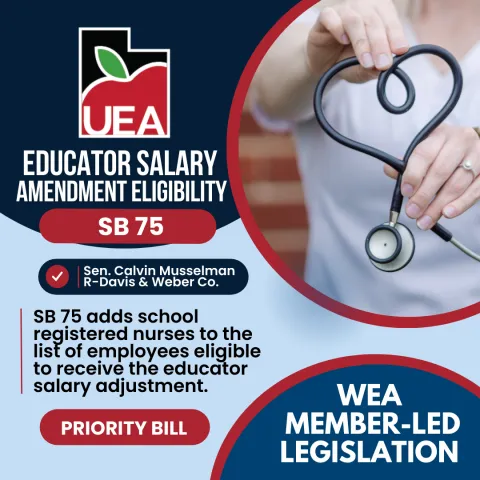
UEA priority bill SB 75 adds school-registered nurses to the list of eligible educators receiving the $10,350 legislative-directed salary enhancement. Sen. Musselman and Weber Education Association member Marie Evans presented the bill to the committee. Sara Jones, UEA Director of Government Relations, spoke in support of the bill as recognizing the work of school registered nurses as educators supporting students in public schools and creating parity in compensation. The bill passed unanimously. The bill has been prioritized to receive $3.2 million in funding and the last step is to pass the House of Representatives.
HB 462 School Bus Internet Access
Rep Auxier presented a bill to create a grant program to help rural school districts provide internet access on certain school buses used for “extended trips”. The only devices that would be able to connect to the school bus internet would be school-issued computers. The grant would provide initial retrofit and one year of connectivity and the school district must commit to covering ongoing costs. The bill passed unanimously.
HJR 8 Joint Resolution Regarding LEA Reporting Requirements
Rep. Welton presented a resolution urging USBE to work with local education agencies to develop more effective, real-time ways to analyze and share the local fiscal impacts of education legislation with lawmakers. UEA supports the resolution and it passed unanimously.
Executive Appropriations Committee
The next step in the budget process began with a meeting of the Executive Appropriations Committee. Individual subcommittees presented their funding recommendations to the committee, which uses them to build the state budget.
The chairs of the Public Education Appropriations Committee presented a detailed report outlining possible increases and reductions to the public education budget. Rep. Jennifer Dailey-Provost asked a number of questions about proposed reductions to National Board Certification stipends, and Sen. Karen Kwan questioned a proposed increase to educator salary adjustment funding that was lower than required.
The report was received, and the committee will work over the next two weeks to finalize the budget.
Certified librarian bill put on hold as committees move education and student health measures forward
February 17, 2026
H.B. 364 Certified Teacher Librarian Amendments
Sponsor: Rep. John Arthur (D) Dist. 41 Salt Lake County UEA Member
Committee: House Education
Summary: Rep. John Arthur introduced a bill that would require school districts or RESAs to employ a certified teacher-librarian to oversee district library practices. The bill is one of three UEA priority bills. Rep. Arthur explained the need to fund certified teacher librarians because multiple policies passed by the legislature over the past few years have defined the required work but haven’t funded the professional educators to do it. He said this has resulted in “unstaffed mandates” from the legislature. There was a lengthy committee discussion about the $1.7 million fiscal note and other elements of the bill. During public comment, many librarians spoke in favor of the bill.
UEA Position: UEA supports the bill. UEA Director of Government Relations, Dr. Sara Jones, spoke about how employing certified teacher librarians supports many legislative goals like improving student literacy, ensuring materials meet state sensitive materials regulations, and providing age-appropriate and engaging reading for all students. When the committee discussed holding the bill, Rep. Hayes asked that the issue be referred to interim “to dedicate efforts to this in the future”.
Vote: The motion to hold the bill passed unanimously.
H.B. 467 Utah Fits All Scholarship Program Amendments
Sponsor: Rep. Candice Pierucci (R), Dist. 49, Salt Lake County, Majority Whip
Committee: House Education
Summary: Rep. Pierrucci presented amendments to the Utah Fits All voucher program. This is the third year in a row the program has been amended since it passed the legislature in 2023. The amendments would establish a new definition of “private school” and impose additional requirements on the program manager to oversee the program.
UEA Position: UEA opposes the bill because the underlying program has been ruled unconstitutional, although that ruling is currently being appealed.
Vote: The bill passed 12-2.
H.B. 129 Sub 1 Education Board Amendments
Sponsor: Rep. Norman Thurston (R) Dist. 62 Utah County
Committee: House Education
Summary: Rep. Thurston presented a substantially pared-down bill with the Substitute. The bill now simply clarifies the State Board of Education’s rulemaking authority.
Vote: The bill passed unanimously.
H.B. 350 Food Available at School Amendments
Sponsor: Rep. Kristen Chevrier (R) Dist. 54 Utah County
Committee: Health and Human Services
Summary: Removes the requirement for school food pantries to only accept donations that are dye and chemical-free
Discussion: Charter school community is concerned about cost since they aren't part of a bigger district food buy-in
Vote: The bill passed unanimously.
HB 81 Sub 3 Dyslexia Testing Amendments
Sponsor: Sen. Jen Plumb (D) Dist. 9 Salt Lake County Minority Assistant Whip
Committee: Health and Human Services
Summary: Establishes a starting point for earlier detection and resources for students with dyslexia
Vote: The bill passed unanimously.
HB 393 Early Intervention for Dyslexia Amendments
Sponsor: Rep. Ariel Defay (R) Dist. 15 Davis County
Committee: Health and Human Services
Summary: Creates a dyslexia screening pilot program and highlights financial considerations for school-based screening programs.
Vote: The bill passed unanimously.
Senate committee advances bills on library policies, curriculum
February 16, 2026
SB 253: Library Materials Amendments
Sen. Michael McKell, R-Utah County, introduced SB 253, which would require local education agencies to adopt a collection development policy outlining library collection and development practices. The bill would also require LEAs to adopt a policy for reconsidering materials in their library collections.
Under the bill, library practices in each school would be under the direction of a teacher librarian or a language arts teacher.
Christy Giblon, president of the Provo Education Association, spoke in favor of the legislation. The Senate Education Committee voted 3-2 to pass the bill with a favorable recommendation.
SB 268: Religious Curriculum in Schools
Sen. Todd Weiler, R-Davis and Salt Lake counties, presented SB 268, which would amend the statutory requirement that Utah State Board of Education-created standards for American constitutional government and citizenship include “the role of religion in United States history and the primacy of religious liberty to American constitutional government.”
The bill also lists a lengthy set of optional religious topics that may be included in instruction.
The Utah Education Association opposes the bill, citing concerns that it would establish a new standard for the 2026-27 school year without sufficient time to revise standards or train teachers on the new requirements. Sara Jones, UEA director of government relations, raised concerns about the implementation timeline during public comment. The committee voted 5-1 to pass the bill.
HB 399 stalls in committee as other House Ed bills advance
February 13, 2026
HB 399 Sub 1 — Prohibition Against Student Character Tracking and Grading Systems
Rep. Trevor Lee, R-Davis County, presented the bill, which would prohibit character education in public schools, including social and emotional learning. The bill would also prohibit “measuring, quantifying, tracking or grading” a student on character education, require the state auditor to collect and report complaints, and create a private right of action for parents to sue. The committee held extensive discussion, though public comment was limited to a few individuals. UEA opposes the bill, and the committee voted unanimously to hold it — meaning no action was taken. The bill could return on a future agenda, but that is unlikely.
HB 197 Sub 4 — School Materials Amendments
Rep. Nicholeen Peck, R-Tooele County, presented a significantly changed and pared-down version of her original bill. The bill would prohibit a local education agency from making available to students material that has been banned through the sensitive materials removal process, which is already law. It would also require an LEA to review all instructional materials for compliance with sensitive materials regulations before they are made available to students. UEA opposes the bill, which passed 9-4.
HB 36 Sub 1 — Gold Medal Schools Pilot Program
Rep. Katy Hall, R-Davis and Weber counties, presented the bill creating a five-year pilot program in rural area elementary schools to promote physical activity and healthy eating habits. The bill would be funded through $3 million in federal rural health transformation funds earmarked for the program. UEA supports the bill, which passed unanimously.
HCR 11 — Resolution Urging Healthy Activities in Schools
Hall also presented a resolution encouraging public schools to prioritize healthy eating education and physical activity. The resolution is nonbinding and would simply encourage schools to participate. It passed unanimously.
HB 440 Sub 1 — School Lunch Amendments
Rep. Tiara Auxier, R-Morgan, Rich and Summit counties, presented a proposal requiring an elementary School Community Council to annually hold a school lunch planning meeting with a structure prescribed in detail in the bill. The purpose is to move toward a goal of 20 minutes of seat time for lunch and having recess before lunch. The bill narrowly passed 7-5.
HB 312 Sub 2 — School Curriculum and Standards Modifications
Auxier presented a significantly revised version of a bill that had been held by the committee earlier in the session. Sub 2 incorporates provisions from Rep. Welton’s bill, HB 518, and would require the Utah State Board of Education to develop “open education resource instructional materials.” UEA opposed the original version but does not yet have a position on Sub 2. The bill passed 13-1.
PEA advances public education budget to EAC; UEA flags stabilization fund concerns
February 11, 2026
The Public Education Appropriations Committee (PEA) unanimously approved its final public education budget proposal on Tuesday and forwarded it to the Executive Appropriations Committee.
Utah Education Association will closely watch EAC’s review, particularly any plan to shift money from the Public Education Stabilization Account, a “rainy day” fund intended to protect full funding of the Weighted Pupil Unit during revenue shortfalls.
UEA is raising urgent questions about the sustainability of drawing on the stabilization account while cutting the income tax. The stabilization account is meant to safeguard public education when revenues are low. Using those funds now to support ongoing programs, while also reducing state revenue, raises concerns about how the state plans to sustainably fund public education in the long run.
The PEA subcommittee reviewed proposed budget cuts and funding priorities, discussed amendments and adopted the final package.
Subcommittee Chair Whyte said the process was intended to identify a 5% reduction to the public education budget, though he noted the final outcome may not ultimately reflect that.
The budget cuts are a state recommendation to offset revenue losses from tax cuts in President Donald Trump’s budget reconciliation bill (commonly referred to as the “Big Beautiful Bill”), which Congress approved in July 2025.
In a big win for educators and students, PEA’s proposal prioritized funding for one of UEA’s priority bills, S.B. 75 Educator Salary Adjustment Eligibility (Rep. Calvin Musselman, R-Weber County), which adds school nurses to the educator salary adjustment.
UEA will continue to monitor EAC as lawmakers consider changes to the proposal in the coming weeks. The first meeting is scheduled for Feb. 18.
House Ed advances key bills on subs, attendance, tech and ethics
Feb. 10, 2026
The House Education Committee advanced several education bills Monday, including measures focused on substitute teaching, attendance, oversight at the Utah Schools for the Deaf and Blind, classroom technology and ethics standards for Utah State Board of Education members.
SB 52: Substitute Teaching Requirements Amendments
This bill removes a prohibition on hiring a non-licensed substitute teacher as a long-term substitute, while maintaining the requirement that schools prioritize licensed educators for substitute roles when possible. UEA supports the bill. It passed unanimously.
SB 58 (Sub. 4): Public School Attendance Amendments
The bill addresses issues related to student chronic absenteeism. UEA supports the bill. It passed the committee unanimously.
HB 448 (Sub. 1): Utah Schools for the Deaf and Blind Amendments
Recent legislative audits identified a need for increased oversight and strategic planning at the Utah Schools for the Deaf and Blind. Developed through USBE workgroups and stakeholder input over many months, the bill addresses four key areas: mission, governance, facilities and data. It passed unanimously.
HB 273 (Sub. 2): Classroom Technology Amendments
Known as the Balance Act, the bill requires USBE to create a model AI policy for LEAs and amend computer science course standards. It also limits technology use in elementary grades and establishes a differentiated, grade-level framework for technology use across K-3, 4-6, middle school and high school. The committee held extensive discussion about the impact of the bill’s requirements. UEA’s current position is watch. The bill passed unanimously.
HB 194: Utah State Board of Education Ethics Amendments
This bill codifies a code of conduct for USBE members and establishes an independent ethics commission to investigate complaints, using language that mirrors the existing legislative ethics commission. The bill passed 9-2.
PEA nears finish as USBE outlines priorities, salary bill advances
February 9, 2026
The Public Education Appropriations Committee (PEA) is nearing the end of its budget work.
Tuesday, Feb. 10, will be the committee’s final meeting day, when members will submit public education budget priorities to the Executive Appropriations Committee (EAC). The EAC is scheduled to meet Feb. 18-19 to finalize the budget.
At the Friday, Feb. 6, meeting, the Utah State Board of Education provided its final response on 2026 education funding priorities. The board emphasized early literacy and numeracy for grades K-8, including additional K-3 paraprofessional support. The request includes ongoing funding increases and some one-time appropriations, along with continued support for arts education through the Beverly Taylor Sorenson Arts Program. USBE also highlighted staffing capacity needs and the importance of teacher support and mentorship programs, while noting budget pressures, proposed reductions and the need to keep specialized educator salaries competitive.
Lawmakers also heard an appropriations request tied to UEA priority S.B. 75 Educator Salary Adjustment (Sen. Calvin Musselman R-Weber County) to include school nurses in the salary adjustment.
Things to watch: Funding decisions in the coming weeks will directly affect early-grade outcomes and staffing capacity. If salary adjustments and specialized programs are not funded, districts could face greater challenges in recruiting and retaining educators.
Budget Review Highlights: Contracts, Tech, and USDB Under the Microscope
February 6, 2026
The Utah State Board of Education (USBE) reviewed major program spending and funding requests on February 4 with a clear focus on accountability as the 5% reduction exercise continues.
USBE walked through how funds in the Contracted Initiatives and Grants line item are distributed across multiple programs and vendors. The discussion focused on ensuring contracts align with legislative priorities and that spending remains accountable under potential budget reductions.
Members also reviewed statewide education technology contracts and their purpose. Some raised concerns about long-term commitments and the need to keep technology investments responsive to classroom and district needs.
A significant portion of the discussion centered on the Utah Schools for the Deaf and Blind, including legislative audit findings and questions about governance, funding and accountability. USBE presented audit findings that cited long-standing issues, including unclear governance, inconsistent data and reporting, and difficulty tying costs to services and outcomes. Members said the findings were not new and emphasized the need for follow-through.
Members questioned whether USDB’s placement under USBE oversight clearly defines roles and responsibilities. The discussion included whether USDB should operate primarily as a direct-instruction provider or as a statewide service provider supporting local education agencies. Several members said clearer statutory direction is still needed.
USBE also reviewed USDB’s funding model, including weighted salary adjustments tied to specialized staffing. Members raised concerns about understanding which costs are fixed versus variable. During the discussion, concerns were raised about proposals or pressures to move USDB educators off the USBE educator salary schedule and onto the state employee salary schedule as part of broader governance changes.
Stakeholders said the state employee salary schedule does not align with educator compensation models and could undermine recruitment and retention for specialized educators serving deaf and blind students. They also warned it could create inequities between USDB educators and similarly credentialed educators in local education agencies. Members noted the issue could resurface and should be monitored for potential impacts on educator compensation and workforce stability.
Members emphasized the need for better enrollment and service data, clearer cost attribution and more consistent reporting. They said future budget decisions should be guided by reliable information and a stronger link between student needs, services and costs. USDB is expected to remain under close legislative watch, with future funding and staffing decisions tied to improved data and reporting, clearer role definition and coordination with local education agencies, and a continued emphasis on sustainability and accountability.
The committee also reviewed requests for appropriations, including the Research, Writing, and Responsible AI Solution (Scrible); Research-Supported Social Health Instructions (We are Friends); United WE Pledge – Give me Liberty Program; Early Interactive Software Program Grant; Course Choice Empowerment – Enrollment Growth; Mentoring and Supporting Teacher Excellence and Refinement tied to HB 146 sponsored by Rep. Pieucci; and Special Needs Educational Assemblies (Remarkability Project).
House Education Committee action on curriculum bills
Feb 5, 2026
H.B. 218 Digital Skills Amendments Rep. Jordan Teuscher (R-Salt Lake County)
This bill changes the requirements for concepts taught in a digital skills course currently required in grade 7 or 8. The bill does not have a fiscal note, so it is not clear how the new standards would be taught to educators responsible for teaching the new concepts. The timeline for implementation is the 2027-28 school year. The bill passed 9-0.
H.B. 312 Civic Education Modifications Rep. Ken Ivory (R-Salt Lake County)
H.B. 312 creates a new requirement for “spiral instruction” on “foundational documents” from kindergarten through grade 12. The requirements for spiral instruction are highly prescriptive and would necessitate developing materials and training educators. The committee did not take action on the bill but voted to hold the bill in committee for further consideration.
H.B. 317 Social Health in Public Education Curriculum Rep. Ken Ivory (R-Salt Lake County)
After extensive committee and public comment, the original version of H.B. 317 was amended to leave in a new definition of “social health” and remove a requirement for teaching social health as part of the elementary health curriculum. The bill passed 8-4.
UEA Opposes SB 85, SB 54 as HB 399 Raises New Concerns
February 3, 2026
Two Senate bills sponsored by Sen. Lincoln Fillmore (R-Salt Lake County) advanced out of the Senate Education Committee, alongside a separate House proposal that the Utah Education Association strongly opposes.
SB 85: Merit pay pilot expansion advances
Sen. Fillmore presented SB 85, a change to a teacher merit pay pilot program first established in 2024. The program provides merit pay for teachers in participating LEAs if they rank in the top 25% of teachers statewide, based on student assessments, parent surveys, professional evaluations and other factors. The bill expands the pilot program to allow teachers to self-nominate if their LEA does not participate because only six districts and 18 charters are currently participating. UEA opposed the original bill because it bases teacher pay on student assessment and opposes the current bill as well. The bill passed 4-2.
SB 54: Carson Smith scholarship changes pass
SB 54 amends provisions of the existing Carson Smith scholarship by eliminating income-based eligibility requirements to receive the scholarship. UEA opposes the bill and it passed 6-0.
Don’t Undo What Works: UEA Warns HB 399 Limits Student Life Skills
The Utah Education Association strongly opposes H.B. 399 Primary and Secondary Education Amendments sponsored by Rep. Trevor Lee (R-Davis County). The bill would roll back Utah's progress by limiting public schools’ ability to teach essential life skills students need to succeed.
Public schools are places where students cultivate a lifelong love of learning, build meaningful relationships and learn how to be caring and responsible adults. From teaching how to read and write to teaching how we successfully navigate our complicated world, schools can and should be a nurturing place for students to prepare for their future.
Utah has made important progress in supporting student well-being and responding to serious challenges facing young people today, including addressing teen mental health, suicide prevention and unhealthy social media use.
Now is not the time to eliminate successful curriculum and support that help students build resilience, strengthen relationships, and thrive in school, the workplace, and their communities.
Teaching life skills empowers students to succeed in K-12 and beyond. These programs work best when they are designed in partnership with families and schools, not restricted by legislation that limits what students can learn.
PEA reviews charter school line item amid budget-cut talks
February 2, 2026
PEA reviews charter school line item amid budget-cut talks
The Public Education Appropriations Committee continues to meet as lawmakers weigh potential budget reductions across public education. During the Feb. 2, 2026, meeting, the discussion centered on the charter school line item and a proposal that would cut a specific training program.
The Legislative Fiscal Analysts and the Utah State Board of Education jointly recommended eliminating the Charter School Training Programs Revision, estimating savings of about $400,000. Charter school representatives objected, arguing that the training is foundational to charter school operations and that eliminating the funds could affect school quality and compliance with required standards.
As an alternative cost-saving measure, charter school advocates suggested reducing or streamlining certain reporting requirements rather than cutting training dollars. Representatives also emphasized a broader policy goal of expanding the number of charter schools in Utah.
The committee also discussed an additional charter school appropriations request. Sen. Heidi Balderree (R-Salt Lake & Utah Counties) submitted a $15 million request tied to S.B. 186 Charter School Base Funding Amendments, which would require a comprehensive study of charter school administrative costs and funding options, establish a Charter School Base Funding Study Group, and direct the state board to report findings to the Legislature by Dec. 1, 2026. The bill also proposes creating Charter School Education Service Agencies aimed at providing economies of scale for charter schools.
UEA WIN! HB 150 advances to support school speech-language pathologists
January 30, 2026
With around 100 educators attending UEA's Educator Day on the Hill on Friday, the House Education Committee was packed for a hearing on UEA's priority bill, HB 150, which would restore support for school-based speech-language pathologists.
Rep. Jill Koford (R-Weber County) presented HB 150, noting that speech-language pathologists were previously eligible for legislative-funded classroom supply funds but were mistakenly removed from eligibility two years ago. HB 150 reinstates that eligibility.
The bill also makes SLPs eligible for the “salary supplement for highly needed educators” program, which provides stipends for positions local school districts identify as highly needed.
Sarah Cox, president of the Weber Education Association, co-presented the bill with Koford as part of UEA’s priority effort.
During the discussion, Rep. Doug Welton (R-Utah County), a high school educator and UEA member, moved to pass the bill and emphasized the need for supplies, noting that an SLP’s need for classroom materials can be even greater than his own.
"It's long overdue that we address this," said Rep. Welton.
The committee passed HB 150 on an 11-2 vote.
Public Education Appropriations (PEA) Update
Jan. 29, 2026
The Public Education Appropriations Committee continues to meet to review budget items, consider proposed cuts and hear from agencies, organizations and legislators requesting appropriations as the committee works through options for balancing the FY 2027 public education budget.
Overall status
- PEA continues to work through FY 2027 public education budget pressures, including proposed cuts, base budget adjustments and competing funding requests.
- Agencies and legislators are presenting line-item justifications, reductions and restoration requests as part of a constrained fiscal environment.
Budget reduction context
- Public education is operating under an assumed 5% reduction scenario, with USBE modeling across-the-board impacts.
- Cuts are a result of the loss of federal funding due to the Big Beautiful Bill.
- Many proposals reflect one-time balance cleanups, vacant FTE eliminations or technical corrections, while others would result in real program impacts if adopted.
Key recurring themes
Tension between cuts and investments
- Several educator-focused programs (e.g., National Board Certification incentives, literacy initiatives, turnaround supports) are simultaneously facing proposed reductions and separate requests to expand or restore.
Shift toward targeted and grant-based funding
- Growth-related grants, pilot programs and competitive funding models are being emphasized over broad formula increases.
Capacity and implementation concerns
- Many initiatives assume additional work by LEAs or USBE without corresponding long-term staffing or guaranteed funding.
Use of one-time funds
- Stabilization funds and one-time appropriations are being used to buffer cuts, raising questions about sustainability.
Agency positions
- USBE has concurred with some targeted reductions (e.g., programs tied to closed entities or excess balances).
- In other areas, USBE highlights significant operational or student impacts if ongoing reductions are adopted.
- USBE has also put forward priority requests tied to literacy, educator retention, mental health, STEM and accountability systems.
Legislator-driven appropriations requests
- Requests range from educator incentives and retention strategies to student support and growth-related infrastructure.
- These requests often conflict with LFA reduction recommendations, forcing prioritization decisions.
Implications for public education
- Short term: Likely flattening or reduction of discretionary programs and increased pressure on educator compensation adjustments.
- Long term: Risk of erosion of retention incentives and support programs if ongoing cuts are adopted without restoration.
- Structural concern: Increasing reliance on temporary or competitive funding rather than predictable base investments.
Big-picture takeaway
The committee is trying to balance fiscal restraint with education priorities, but faces difficult trade-offs between maintaining core operations and investing in educator workforce stability and student supports.
Appropriations requests heard Jan. 29, 2026
National Board-Certified Teacher Incentive Program — Rep. John Arthur
- Requested funding to restore and expand educator incentives tied to National Board Certification.
Economic Mobility/Community Partnerships Initiatives (S.B. 165 framework)
- Requested support for a grant program that funds community-based partnerships, with LEAs as optional partners.
- While not a traditional education line item, it “touches public education through literacy, graduation and postsecondary outcomes,” which is why it landed in PEA discussion.
Senate panel advances tax bills that could squeeze school funding and local control
January 29, 2026
The Senate Revenue and Tax Committee advanced three tax bills that could affect how education dollars flow and how much revenue is available for public schools in future years.
S.B. 65, Minimum Basic Tax Rate Amendments, sponsored by Sen. Lincoln Fillmore, would route a locally imposed school levy through the state. Under the bill, local school districts would levy and collect the revenue, send it to the state, and the state would redistribute it back to districts. The bill language points to funds flowing through the Uniform School Fund rather than the unrestricted General Fund. Still, concerns remain that centralizing the money could reduce local control and give the Legislature greater discretion over how education dollars are handled. The State Auditor raised concerns about the structure, including potential accounting and legality issues. The committee passed the bill 4-1. Several members urged further work with the State Auditor’s Office. The next step is Senate first reading.
S.B. 116, Income Tax Rate Amendments, also sponsored by Fillmore, would create an automatic tax cut trigger when actual state revenue exceeds projected revenue. The bill would use a formula-based approach rather than requiring lawmakers to vote annually on tax rate changes. Committee members raised concerns about reduced flexibility during economic swings and how automatic reductions could affect long-term revenue stability. Questions were also raised about how the proposal could interact with current 5% budget cut requests for state agencies, including public education. The committee passed the bill 3-2.
S.B. 60, Income Tax Rate Amendments, sponsored by Sen. Dan McCay, would reduce Utah’s income tax rate from 4.5% to 4.45%. Lawmakers questioned the timing of cutting taxes in a year when appropriation committees have been asked to reduce budgets by 5%. Members also noted income tax is a major funding source for education, and even small cuts can add up over time. The committee passed the bill 4-1, along party lines.
House panel advances educator pipeline, fee waiver bill as budget cuts loom
January 28, 2026
Utah lawmakers weighed several education bills Tuesday, Jan. 27, as the House Education Committee voted to advance proposals on school fees, educator workforce needs and school safety policies. Meanwhile, the Public Education Appropriations Committee continued working through proposed cuts tied to federal tax changes, with state leaders modeling how to meet a required 5% budget reduction.
House Education Committee
HB 106, Student Attendance Changes would direct the Utah State Board of Education to study chronic absenteeism, collect data, identify root causes and make policy recommendations to the Legislature by September 2027. The Utah Education Association supports the bill. Committee members focused discussion on how HB 106 would coordinate with existing absenteeism-related laws. The committee voted to hold the bill and revisit it on a future agenda once coordination is complete.
HB 142, School Fee Waiver Amendments would limit fee waivers to two per student for school trips lasting two or more nights. For a second trip, a qualifying student could request a waiver after meeting with the principal to develop an action plan that includes a school-related contribution. UEA opposes the bill. The committee passed HB 142 unanimously.
HB 163, Grow Your Own Educator Pipeline Program Amendments would expand the state’s existing Grow Your Own Educator program to include licensed special education teachers, in addition to the licensed school counselors, psychologists and social workers it currently supports. UEA supports the bill, which passed unanimously.
HB 227, Student Journalist Amendments would establish protections for student speech and press in school-sponsored media, with specified limits such as libel, slander, or obscenity, and would require a written policy. The committee raised concerns about the bill’s structure, unintended impacts and the need for additional clarification. Sara Jones, UEA government relations director, told the committee there was a lack of clarity around potential liability for school employees. The committee tabled the bill on a 9-3 vote, meaning no action was taken and it will not be debated again.
HB 299, School Response to Sexual Offense would add clarifying language to the existing law requiring local education agencies to adopt a policy addressing when crimes are considered “committed.” The bill would more precisely require a policy for circumstances in which a student has been arrested for, charged with, or adjudicated in the courts for committing a serious offense or sexual crime. The committee passed HB 299 unanimously.
HB 193 would shift benefit decisions from local employers to the state
HB 193, Transgender Medical Procedures Amendments, sponsored by Rep. Nicholeen Peck, R, District 28, Tooele County, would prohibit state insurance plans and those offered to public employees from covering transgender medical care, including plans offered through public employers such as school districts.
A substitute version would allow individuals currently receiving transgender medical care to continue that care until treatment is completed and a physician indicates it is still needed. It would also require insurance to cover detransition-related care for individuals who choose to pursue it.
Before HB 193, school districts and other public employers could decide locally whether to offer coverage for this type of care. The bill would move that decision from local employers to the state, with implications for employee benefits, recruitment, retention and local control. The bill passed out of a House committee and is headed to the House floor next.
Public Education Appropriations Committee
State budget writers continued evaluating options to address a required 5% cut, after federal tax cuts included in President Donald Trump’s “Big Beautiful Bill,” passed by Congress in July 2025. UEA’s position is that public schools need more funding to fully support students, not less.
Two issues remain key to watch as lawmakers work through proposed reductions: a potential education salary adjustment change from 4% to 3%, and continued modeling by the Utah State Board of Education for a potential 5% across-the-board cut. The committee’s next meeting is on Thursday at 8 a.m.
Public school funding shift advances; tax-return option targets lunch debt
January 27, 2026
SB 62, School Funding Amendments
Sen. Lincoln Fillmore, R-District 17, Salt Lake City
Sen. Fillmore’s bill proposes a significant change to a public school funding mechanism. Currently, schools are funded based on the prior-year ADM (average daily membership) plus enrollment growth. If the bill passes, ADM would no longer be used, and the Oct. 1 student count would be used instead. Sen. Fillmore believes the proposed change would more accurately fund where students are attending school, but the concern is that losing ADM would reduce stability and predictability in year-to-year funding. If the change is made, it would reallocate about $77 million, and the current bill does not include provisions for where that money would be reallocated. The bill is expected to be revised as the budget process moves forward. The bill passed 4-2.
HB 148, Tax Return Donation Amendments
Rep. Matt MacPherson, R-District 26, Salt Lake County
HB 148 creates a voluntary option for Utah taxpayers to donate a portion of their state tax return to help pay down school lunch debt in local school districts. The contribution is optional, and taxpayers may choose to donate any amount. This approach allows Utahns to directly support students and families while keeping participation voluntary.
The bill passed unanimously out of committee, where it received bipartisan praise from committee members. Legislators highlighted the bill as a practical solution that addresses a growing challenge faced by schools.
HB 148 is a positive step forward that would support school districts and help ensure students across the state have access to meals without the burden of unpaid lunch debt.
5% public education budget cuts ahead: what the appropriations subcommittee discussed Jan. 23
January 26, 2026
The Public Education Appropriations Subcommittee (PEA) met Friday, Jan. 23, to discuss a required 5% cut to Utah’s public education budget, directed by the Executive Appropriations Committee. The cuts are needed because of the loss of federal funding tied to President Donald Trump’s “Big Beautiful Bill,” which was signed into law in July 2025.
The subcommittee heard three presentations (each taking a very different approach) from Legislative Fiscal Analysis (LFA), the Utah State Board of Education (USBE), and the Governor’s Office.
LFA approach: formula adjustments instead of program cuts
The Legislative Fiscal Analysis’ proposal focused on statewide formula adjustments and reduced growth assumptions, rather than cutting specific schools or programs outright. Major components included savings from enrollment growth, reversing a planned deposit to the Public Education Stabilization Account, and reducing flexible funding to districts and charters. A significant impact of this approach is educator pay: LFA proposes a 5% educator salary increase, rather than the expected 4%, by tying the increase to current-year inflation rather than prior-year WPU growth. This change would be felt statewide.
USBE approach: flat reductions across programs
The Utah State Board of Education largely proposed a flat 5% cut across nearly every program, including state-level programs and grants, administrative functions, and major Minimum School Program items such as educator salary adjustments, student supports, and transportation. Some committee members expressed frustration, noting that the approach lacked prioritization and failed to distinguish between high-impact programs and lower-priority items.
Governor’s Office: priorities without specific cuts
The Governor’s Office did not present specific reductions. Instead, they offered a values-based framework to guide legislative decisions, emphasizing the importance of protecting educator compensation, literacy initiatives, and school safety.
Why this matters
No matter which approach lawmakers choose, the challenges for public education are real. Cuts will affect educator pay, student supports, and classroom resources. Impacts will be felt statewide, especially in a system that serves the vast majority of Utah’s students.
The UEA believes the only way to reduce harm to public education is to cut funding from the unconstitutional Utah Fits All program. Right now, it is funded at $122 million a year, while the State of Utah is appealing the ruling in a UEA lawsuit that found it unconstitutional.
By shifting cuts there, the legislature can better protect public schools that serve more than 90% of Utah students. Contact your legislators and urge them to protect public school funding.
Senate Education Committee advances UEA-backed bill to include school nurses in salary adjustment
January 22, 2026
The Senate Education Committee held its first meeting of Utah’s 2026 legislative session on January 22, advancing several bills, including SB 75 — a Utah Education Association legislative priority — with multiple measures receiving unanimous support.
SB 75, Educator Salary Adjustment Eligibility, would add school-registered nurses to the legislative educator salary adjustment program, valued at $10,350 per year. Sen. Calvin Musselman presented the bill on behalf of UEA, joined by Marie Evans, a Weber Education Association member and school registered nurse. The committee passed the bill unanimously.
Other measures advanced by the committee include:
- SB 51, School Safety Modifications (Substitute 1): Requested by the legislative School Security Taskforce, the bill would create a process for local education agencies to share information about credible student threats when students transfer between LEAs. It passed unanimously.
- SB 69, School Device Revisions (Substitute 1): The bill would expand last year’s restriction on student cellphone use during instructional hours to a bell-to-bell prohibition, while keeping exemptions (including medical necessity and IEP plans) and adding allowances for LEA-determined exemptions. It would take effect July 1. The bill passed 6-1, with Sen. Riebe voting no, citing concerns it is “heavy-handed.”
- SB 119, School and Classroom Amendments: The bill would change how the public education economic stabilization account may be used, including allowing stabilization funds to cover the inflationary adjustment to the Weighted Pupil Unit under certain federal tax policy impacts. The bill passed 4-2.
- SB 52, Substitute Teaching Requirements Amendments: The bill would remove the requirement that long-term substitute teachers hold a teaching license. Davis Education Association President Kallyn Gren spoke in support, citing the challenges of securing long-term coverage in an emergency. The bill passed unanimously.
- SB 58, Public School Attendance Amendments: In response to concerns identified in a Utah State Board of Education audit, the bill would create uniform statewide definitions for attendance in traditional and virtual schools, along with uniform monitoring and accountability requirements for LEAs. It also would allow school community councils to use school trust funds to address chronic absenteeism. The bill passed 3-1.
- SB 88, School Technology Amendments: The bill would require LEAs to provide a parent-accessible monitoring system for student use of school-managed devices and adopt content filtering that limits access to preapproved websites and digital resources. The bill passed 3-1.
The Public Education Appropriations Subcommittee met Jan. 21, 2026, receiving a briefing from the Utah State Board of Education on its strategic plan and reviewing the public education base budget — the starting point for appropriations as lawmakers consider adjustments for inflation, enrollment changes and technical updates.
Base budget highlights presented to the subcommittee show public education funding projected to increase by about $191 million to keep up with inflation, a 4.2% increase reflected in per-student funding. The proposal also includes about $43 million added to the education stabilization account and about $19 million more for educator pay adjustments tied to growth in eligible educators.
A projected statewide enrollment decline of just over 2% is expected to reduce funding by about $28 million in the basic school program, with reductions in several programs to match lower enrollment. After offsets, ongoing funding is reduced by about $12.5 million, with a one-time $6.4 million backfill in the current year.
The presentation also notes continued decreases in school property tax rates, while total local revenue increases due to higher property values.
Section with embed

We can be confident that policymakers take public education seriously when making decisions because of the efforts of this team. They are intelligent, thoughtful, tough and effective.